
Process Complementarity and Value Creation in SME Digital Transformation
Authors
Key Information
Journal
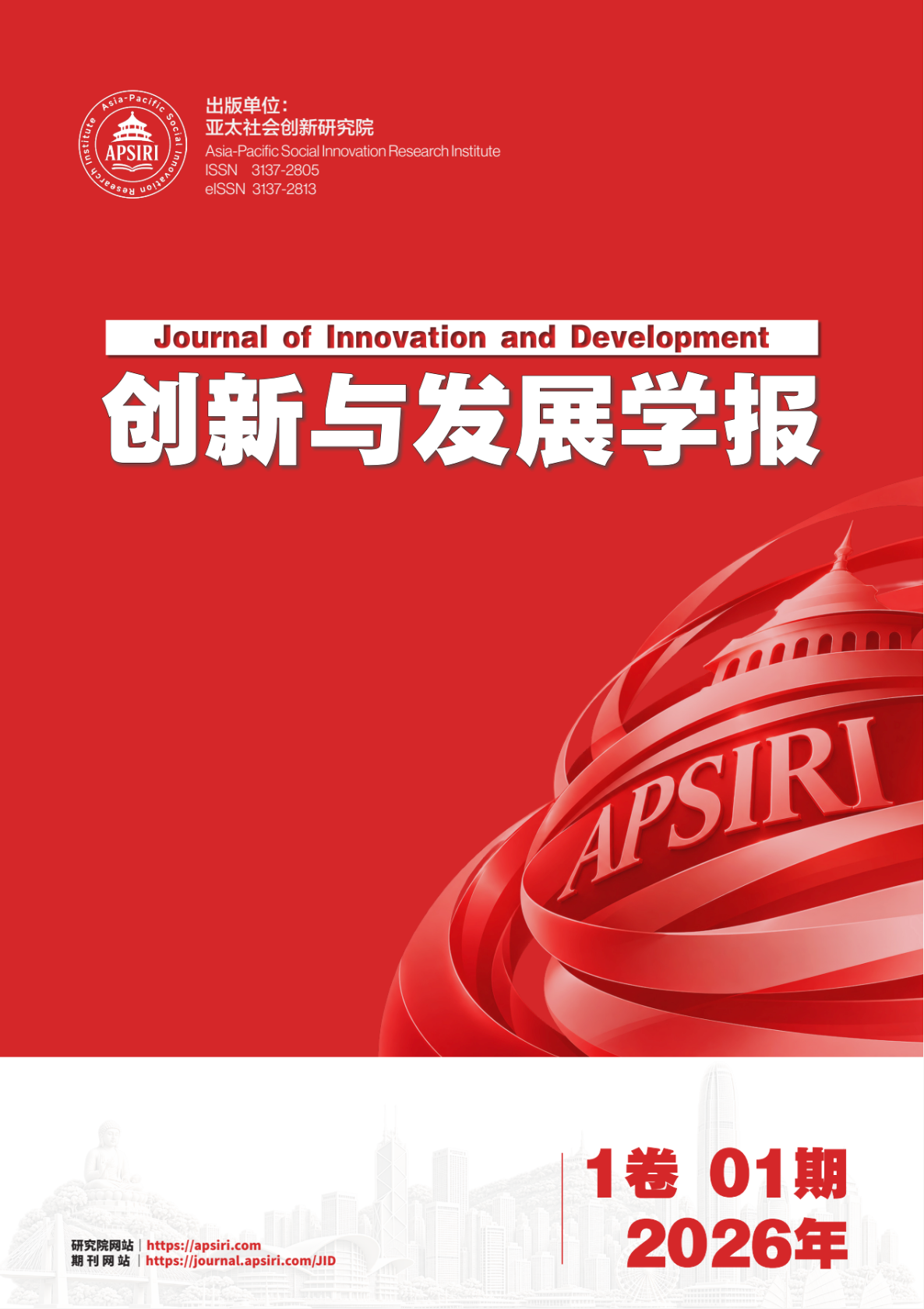
Published in Vol. 1 No. 1 (2026) of Journal of Innovation and Development.
Journal of Innovation and Development is an international, interdisciplinary academic journal published by the Asia-Pacific Social Innovation Research Institute. It is committed to publishing original research of academic value and practical significance in the fields of innovation and development. Open to researchers worldwide, the journal focuses on scientific and technological innovation, engineering, digital applications, industrial upgrading, ecology and sustainable development. It encourages interdisciplinary research and diverse academic perspectives, so as to advance knowledge creation, academic exchange and the dissemination of research findings.
About the JournalAbstract
Digital tools make information processing more accessible to small and medium-sized enterprises, yet converting technology investment into business value requires organizational coordination. Drawing on digital transformation and dynamic capability research, this article examines data quality, the allocation of decision rights, and coordination across interdependent business processes. Information visibility enables the detection of operational exceptions; decision rights determine whether these signals lead to action; and coordination determines whether local improvements translate into enterprise-level gains. External services lower technical entry barriers while changing the judgment capabilities and cooperation boundaries that firms need to retain. Transformation should therefore be organized around complete business events, with performance assessment linked to changes in processes and their associated costs. Problem-oriented pilots and expansion guided by complementary organizational conditions offer an explanation for differences in performance among firms adopting similar tools.
References
[1] VIAL G. Understanding digital transformation: A review and a research agenda[J]. The Journal of Strategic Information Systems, 2019, 28(2): 118-144. DOI: 10.1016/j.jsis.2019.01.003.
[2] VERHOEF P C, BROEKHUIZEN T, BART Y, et al. Digital transformation: A multidisciplinary reflection and research agenda[J]. Journal of Business Research, 2021, 122: 889-901. DOI: 10.1016/j.jbusres.2019.09.022.
[3] OECD. SME digitalisation to manage shocks and transitions: 2024 OECD D4SME survey[R/OL]. Paris: OECD Publishing, 2024[2026-10-13]. https://doi.org/10.1787/eb4ec9ac-en.
[4] BIANCHINI M, LASHERAS SANCHO M. SME digitalisation for competitiveness: The 2025 OECD D4SME Survey[R/OL]. Paris: OECD Publishing, 2025[2026-10-13]. https://doi.org/10.1787/197e3077-en.
[5] ELLER R, ALFORD P, KALLMÜNZER A, et al. Antecedents, consequences, and challenges of small and medium-sized enterprise digitalization[J]. Journal of Business Research, 2020, 112: 119-127. DOI: 10.1016/j.jbusres.2020.03.004.
[6] TEECE D J. Explicating dynamic capabilities: the nature and microfoundations of (sustainable) enterprise performance[J]. Strategic Management Journal, 2007, 28(13): 1319-1350. DOI: 10.1002/smj.640.
[7] 王京滨, 刘赵宁, 刘新民. 数字化转型与企业全要素生产率——基于资源配置效率的机制检验[J]. 科技进步与对策, 2024, 41(3): 23-33. DOI: 10.6049/kjjbydc.2022100126.
[8] 陈灿君, 吕乐琳, 许长新. 家族控制视角下数字化转型对企业全要素生产率的影响研究[J]. 财经论丛, 2025, 41(8): 100-111. https://cjlc.zufe.edu.cn/CN/Y2025/V41/I8/100.
[9] OECD. Generative AI and the SME workforce: New survey evidence[R/OL]. Paris: OECD Publishing, 2025[2026-10-13]. https://doi.org/10.1787/2d08b99d-en.
[10] 工业和信息化部办公厅. 关于发布中小企业数字化水平评测指标(2024年版)的通知:工信厅企业〔2024〕56号[EB/OL]. (2024-09-04)[2026-10-13]. https://www.miit.gov.cn/jgsj/qyj/wjfb/art/2024/art_2817ddce6c39400099c294ac7b6f8439.html.
Details
License
Copyright (c) 2026 正跃 张 (作者)

This work is licensed under a Creative Commons Attribution 4.0 International License.